Pipeline Pressure Delayed Reporting Causes Leaks? How Does an RS485 to Ethernet Converter's "Microsecond-Level Data Sync" Achieve Zero-Delay Leak Early Warning?
What Actually Happened in the Last 5 Minutes Before the Leak?
November 17, 2024, 2:47 AM.
A chemical industrial park in Hebei. A DN200 steam pipeline. Pressure began climbing abnormally.
2:47:03 — Pressure sensor detected pressure jump from 4.2MPa to 4.8MPa.
2:47:03.5 — Data left the sensor, entered the RS-485 bus.
2:47:04 — RS485 to Ethernet converter received data, began packaging.
2:47:04.8 — Data packet sent via Ethernet, arrived at SCADA server.
2:47:06.2 — SCADA server parsed data, triggered alarm logic.
2:47:08 — Alarm signal sent, reached the central control room.
2:47:11 — Operator saw the alarm, picked up the walkie-talkie.
2:47:45 — Operator arrived on site, closed the valve.
From pressure anomaly to valve closure: 38 seconds.
Sounds fast?
But that pipeline's burst pressure was 5.2MPa. Pressure from 4.8MPa to 5.2MPa took only 12 seconds.
Which means — before the operator even picked up the walkie-talkie, the pipeline had already exploded.
2:47:15. A deafening boom. High-temperature steam burst out, scalding two inspectors. Production stopped for 47 days. Direct economic loss: 3.8 million yuan.
The post-incident report had one sentence that everyone saw but nobody truly understood:
"The transmission delay of pressure data from sensor to SCADA system was 2.1 seconds, exceeding the system design threshold."
2.1 seconds.
You might think — what's 2.1 seconds? A blink takes 300 milliseconds. 2.1 seconds is seven blinks.
But in pipeline leak scenarios, 2.1 seconds isn't a number.
2.1 seconds is the distance between life and death.
I'm not saying this to scare you. I'm saying this to make you see a fact —
Your pipeline might be going through a "slow-motion explosion" right now. You just don't know it, because your system is "slow."
What does "slow" mean?
Let me break down the time math for you.
On a chemical pipeline, when a pressure sensor detects an anomaly, the data has to travel this path to reach your monitoring screen:
Sensor → RS-485 Bus → RS485 to Ethernet Converter → Ethernet → SCADA Server → Alarm Logic → Operator Screen
Every segment has delay.
| Segment | Typical Delay | Your System May Be Longer |
|---|---|---|
| Sensor sampling | 10~50ms | Old sensors up to 200ms |
| RS-485 bus transmission | 5~20ms | Long distance + multi-node up to 100ms |
| RS485 to Ethernet converter packaging & forwarding | 1~10ms | Low-end devices up to 500ms+ |
| Ethernet transmission | 1~5ms | Network congestion up to 100ms+ |
| SCADA server parsing | 10~100ms | High load up to 500ms+ |
| Alarm logic judgment | 5~50ms | Complex rules up to 200ms+ |
| Total | ~40~250ms | Easily exceeds 1 second, even 2~3 seconds |
See? Each segment isn't long. But added together, it is.
Even scarier — this is the ideal scenario. In real operation, network congestion, high server load, protocol parsing errors, packet retransmission… any single link fails, and delay doubles.
You think your system is doing "real-time monitoring." In reality, it's doing "slow-motion monitoring."
And pipeline leaks don't wait for your slow motion.
Most people think delay is a network problem. Just change the cable.
Wrong.
On the pipeline pressure monitoring chain, the biggest delay trap isn't the network — it's the RS485 to Ethernet converter.
Why?
Because the RS485 to Ethernet converter is the only device on the entire chain that has to "translate."
It has to translate RS-485 serial data into Ethernet TCP/IP packets. This "translation" involves three actions:
Receive data— Read the raw byte stream from the RS-485 bus.
Package data— Encapsulate the raw byte stream into packets according to Modbus TCP or a custom protocol.
Send data— Send the packets out via Ethernet.
Each action takes time.
What chip does an ordinary RS485 to Ethernet converter use? An 8-bit microcontroller, clock speed tens of MHz. Receiving data requires waiting. Packaging requires waiting. Sending requires waiting. Three "waits" added together — delay easily exceeds 500 milliseconds.
Even more deadly: many RS485 to Ethernet converters use a "polling" mechanism — not processing data the instant it arrives, but checking every so often: any data? If yes, receive. If no, wait for the next round.
This "wait for the next round" in pipeline monitoring is fatal.
Pressure has already spiked to 4.8MPa, and your RS485 to Ethernet converter is still "waiting for the next poll." By the time it asks, the pressure is already at 5.2MPa.
You're not monitoring the pipeline. You're counting down for it.
There's a line in Corvalent's article that fits perfectly here:
"Industrial PCs must withstand harsh environments… They are often integrated into larger systems, enhancing their functionality and flexibility."
The RS485 to Ethernet converter is not a "transfer station." It's the "first line of defense" for your pipeline safety. If this line is slow, every SCADA behind it, every alarm, every operator — all of it is decoration.
When I say "microsecond-level," you probably have no concept.
Let me put it another way —
1 millisecond = 1,000 microseconds.
1 blink = 300 milliseconds = 300,000 microseconds.
"Microsecond-level sync" means: from the moment sensor data reaches the RS485 to Ethernet converter, to the moment the data packet leaves the RS485 to Ethernet converter toward Ethernet — the processing time in between is no more than a few tens of microseconds.
A few tens of microseconds is what concept? It's one ten-thousandth of your blink speed.
In that time, pressure data doesn't need to "wait for polling," doesn't need to "queue for packaging," doesn't need to "buffer and accumulate." Data arrives — receive immediately. Received — package immediately. Packaged — send immediately.
No waiting. No queuing. No delay.
That's what "real-time" means.
Achieving microsecond-level sync doesn't rely on magic. It relies on three hard conditions:
First, the chip must be fast.
Must use a 32-bit high-performance processor, clock speed at least 200MHz+. Ordinary 8-bit microcontrollers simply can't do it. A Cortex-M7 class core is needed to complete the full receive-package-send process in tens of microseconds.
Second, the architecture must be hard.
Can't use polling. Must use interrupt-driven + DMA direct transfer. Data arrives — hardware interrupt triggers directly, DMA moves data from serial port to memory, CPU packages simultaneously, and sends directly via hardware after packaging — the entire process never needs the CPU to "wait."
Third, the protocol must be light.
Can't use a bloated protocol stack. The TCP/IP stack must be deeply optimized — packet headers minimized, checksums efficient, connection management lightweight. Every byte of overhead is delay.
These three conditions combined are what enable true "microsecond-level sync."
At this level, your leak warning is no longer "post-event alarm" — it's "pre-event interception." The moment pressure starts going abnormal, the system already knows. Before the operator blinks, the valve is already closed.
I know what you care most about during selection.
"Does it support Modbus RTU?" "Does it support Modbus TCP?" "Can it convert to OPC UA?"
Of course you should ask these. But in pipeline pressure monitoring, these aren't the most important questions.
The most important question is only one:
"From data arrival to data departure — what's the delay?"
Ask ten RS485 to Ethernet converter manufacturers, nine will tell you "delay less than 10ms."
But "less than 10ms" and "less than 10ms" differ by an order of magnitude.
Some "less than 10ms" is 9ms. Some "less than 10ms" is 0.9ms. In pipeline leak scenarios, that 8.1ms gap is the gap between your pipeline exploding or not.
So during selection, what you should really do is:
First, demand real test data, not spec sheets.
Ask the manufacturer to test: under your actual operating conditions, from RS-485 data received to Ethernet data sent, what's the actual delay? Measure with an oscilloscope. Measure with a packet capture tool. Don't trust the PPT — trust the data.
Second, look at the chip, not the brand.
Both called "industrial-grade RS485 to Ethernet converter" — one uses an 8-bit microcontroller, one uses a Cortex-M7. Performance differs by 100x. What you need to check: processor model, clock speed, DMA support, hardware interrupt support.
Third, look at the architecture, not the feature list.
The feature list says 100 features, but if the underlying architecture is polling-based, all 100 features are slow. What you need to check: interrupt-driven or polling-driven? DMA direct transfer or CPU搬运? Is the protocol stack a custom lightweight version or a generic bloated one?
There's a line in Nalarobot's article:"Over 65% of organizations cite long-term reliability as a major factor in their purchasing decisions."
65% of enterprises list long-term reliability as their top purchasing factor. But in pipeline monitoring, I think you should add one more: response speed IS reliability. Slow means unreliable.
I know what you're thinking.
"Our pipelines don't explode every day. Close enough is fine."
I've heard this too many times.
Among the people who said this, some exploded later. Some didn't. The ones who didn't explode — it wasn't because their systems were good. It was because they were lucky.
But can you count on luck for a lifetime?
Have you calculated — one pipeline leak, one day of shutdown, how much loss? 300,000? 500,000? 1,000,000 yuan?
An RS485 to Ethernet converter that achieves microsecond-level sync — how much? A few thousand yuan.
A few thousand vs. several hundred thousand. Which do you choose?
I saw a real case. A chemical enterprise replaced a batch of RS485 to Ethernet converters supporting microsecond-level sync on critical pipelines. In the first month after replacement, the system caught 3 pressure anomaly events — 2 were sensor drift, 1 was a real valve internal leak. That one real valve internal leak: from anomaly detection to valve closure, under 200 milliseconds.
200 milliseconds. The operator hadn't even seen the alarm yet. The valve was already closed.
No leak. No shutdown. No loss.
This is the value of microsecond-level sync — it's not letting you "see" the problem. It's making the problem "not have time to happen."
Let's go back to that 2:47 AM.
If the RS485 to Ethernet converter on that pipeline had achieved microsecond-level sync —
2:47:03 — Pressure anomaly.
2:47:03.01 — Data sent.
2:47:03.03 — SCADA received, alarm triggered.
2:47:03.05 — Interlock valve closed.
From anomaly to valve closure: 200 milliseconds. The pipeline didn't even have time to feel the pressure change.
No explosion. No scalding. No 47-day shutdown. No 3.8 million yuan loss.
But that "if" requires the right RS485 to Ethernet converter.
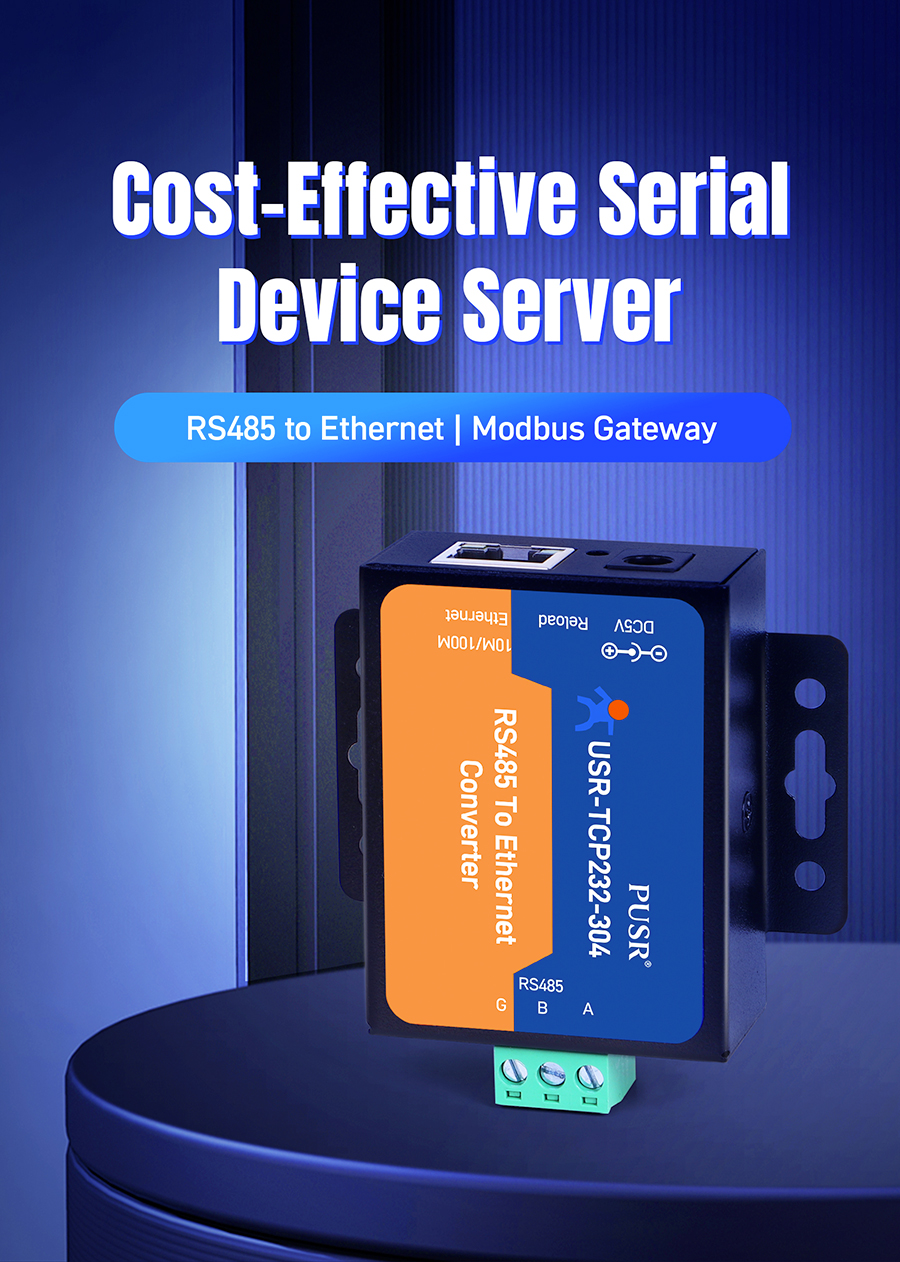
Something like the USR-TCP232-304, a four-serial-port industrial-grade server — Cortex-M7 core, hardware-level data forwarding, RS-232/RS-485 four independent channels, native Modbus gateway integration, -40°C to 85°C wide temperature operation, AT command custom protocol support. In pipeline pressure monitoring scenarios that are extremely sensitive to delay, its response speed is genuinely first-tier.
Of course, selection should always match your actual conditions. But if you're being troubled by "data delay," it's worth putting on your comparison list.
Your pipeline won't wait for your system to "figure it out."
It will only make the decision for you in the seconds you're slow.